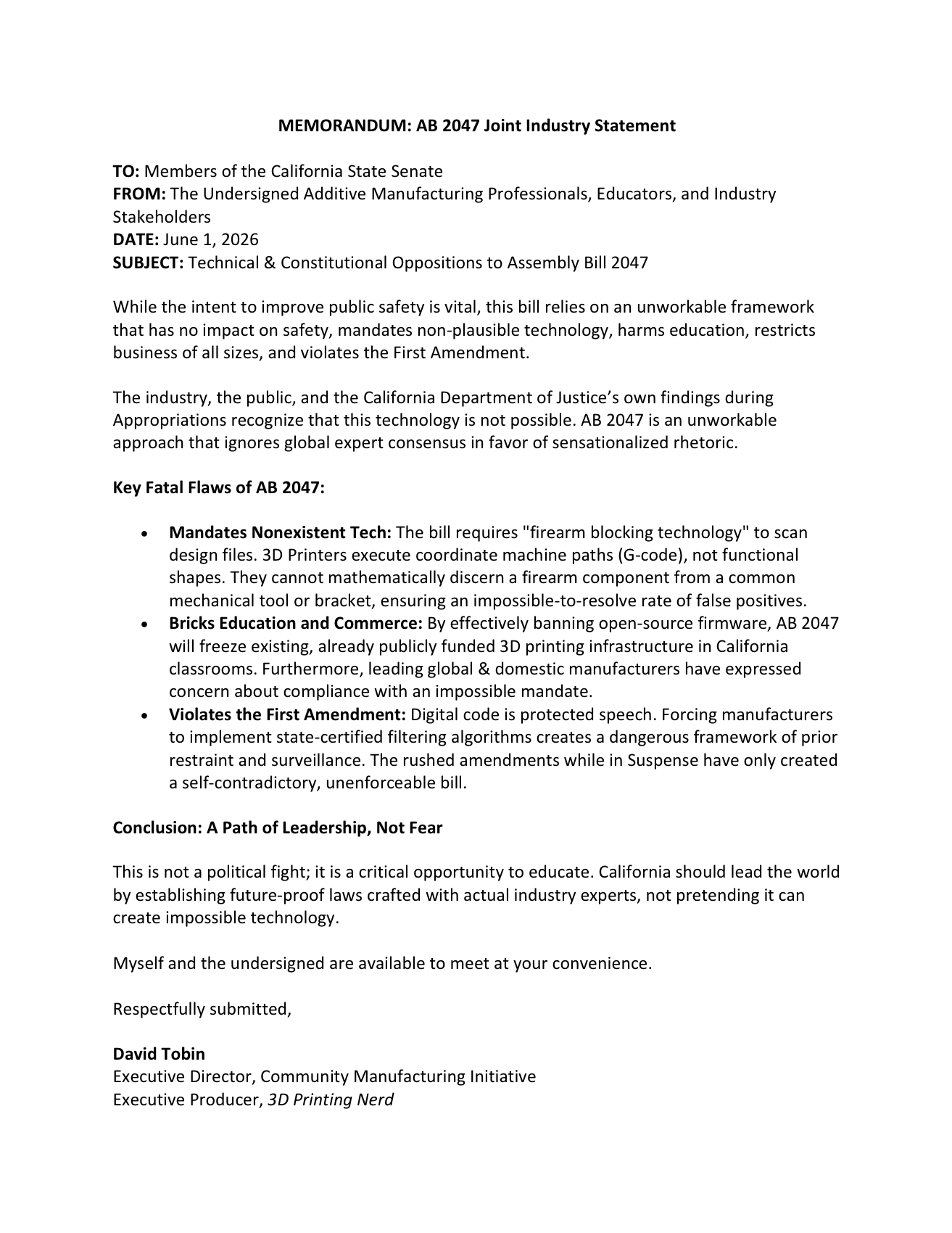
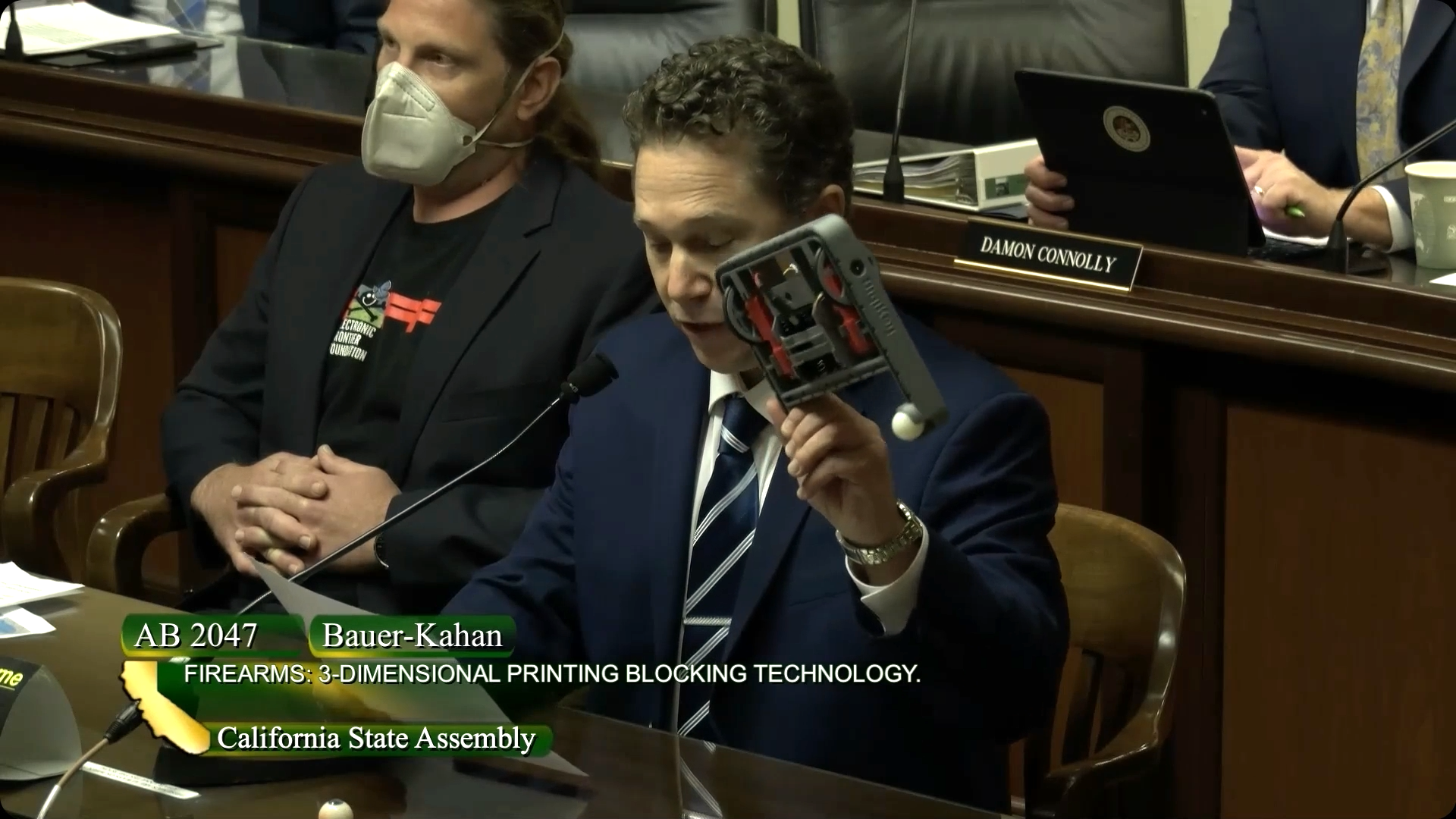
AB2047 requires every 3D printer sold in California to run a DOJ state-certified "detection algorithm" - a technology that can not reliably exist. If passed, it would pull a tool used in thousands of schools, libraries, labs, and small businesses out from under our communities. This page is a plain-language guide you can share with your school board, PTA, or neighbor.
Each takes five minutes or less. Do one today. Do all three this week.
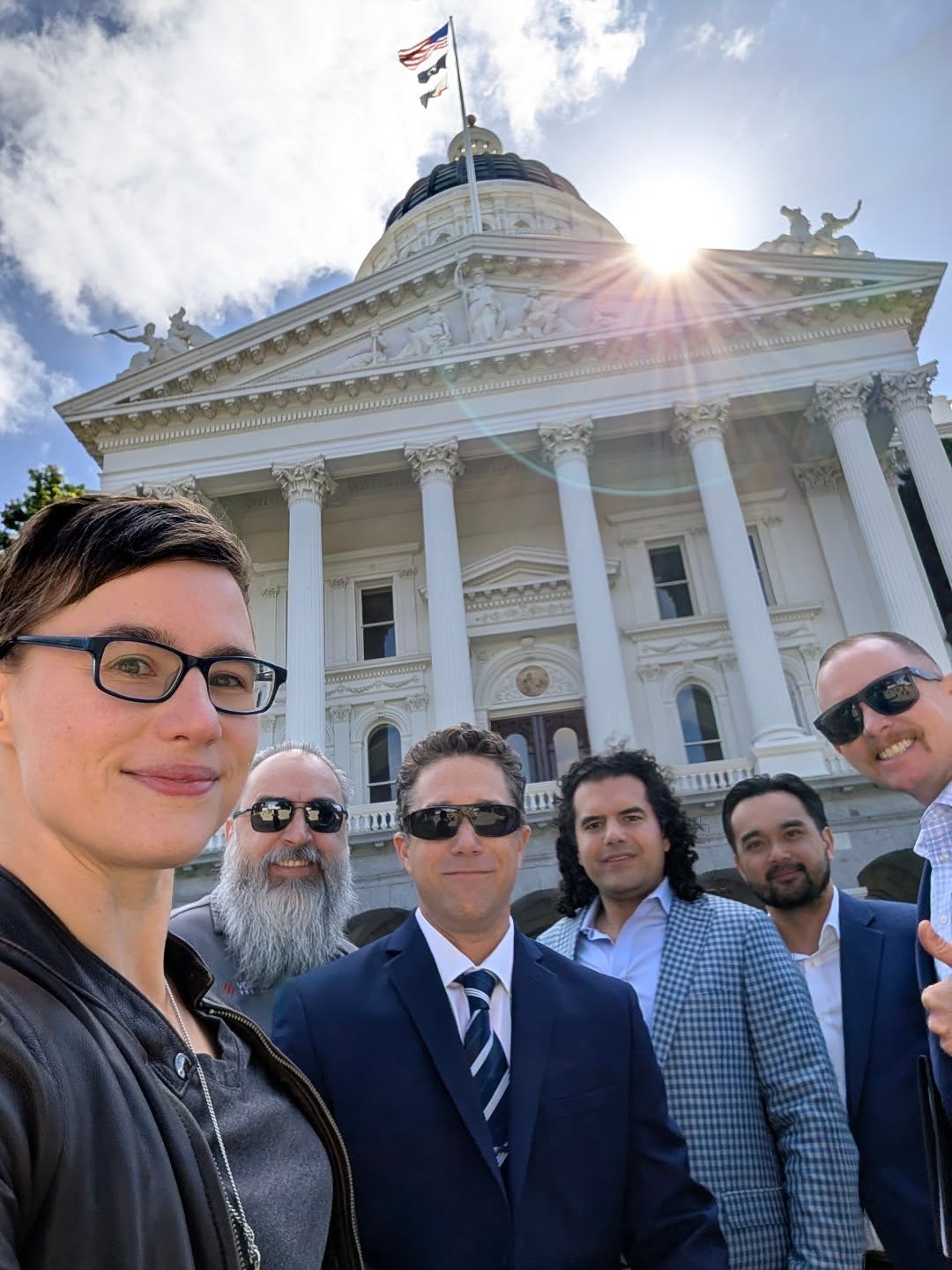
Schedule a meeting with Asm. Rebecca Bauer-Kahan, the bill's author. Direct conversation matters most.
Add your name on Change.org - Stop AB 2047: Protect Access to 3D Printers in California.
Phone calls beat emails. Two minutes, big impact.
AB2047 rests on two foundations that cannot bear its weight: the legal foundation conflicts with established First Amendment law, and the technical foundation assumes capabilities that do not reliably exist.
CAD files and source code are protected expression; mandatory pre-review is a textbook prior restraint.
Forcing manufacturers to attest to contested algorithm output is compelled speech on a public concern.
Shapes shared between firearm parts and countless legitimate objects give no clear notice of prohibited conduct.
The bill sweeps in general-purpose hardware used overwhelmingly for lawful purposes.
A state-specific approved list for interstate hardware raises serious Dormant Commerce Clause issues.
Federal law already covers firearm manufacture, including via additive manufacturing.
Delegation, due process, Fourth Amendment telemetry, and state constitutional issues.
A rifled barrel is a grooved cylinder. So are industrial screws, optical mounts, and thousands of other parts.
Rotation, scaling, splitting a model into parts, or re-exporting defeats shape-based detection - without losing function.
By the time a printer sees G-code, shape context is gone. Reconstructing a "firearm" at print time is intractable.
Marlin, Klipper, and RepRap firmware can be flashed in minutes. Software-level "blocks" are simply removable.
There is no authoritative dataset of "firearm blueprints" - and the set grows adversarially.
Research on shape-based detection consistently shows error rates incompatible with general-purpose use.
Remote-print workflows, procedural generation, encrypted slicer output, multi-material composites, and more.
AB2047 has cleared Public Safety and Judiciary, and is now scheduled for the Assembly Appropriations Committee hearing on Tuesday, May 13 at 9:00 AM (1021 O Street, Room 1100, Sacramento). This is the cheapest point - in time, money, and political capital - for public input. Engagement now is worth far more than engagement later.
AB2047 is introduced in the California State Assembly, framed as a public safety measure targeting 3D-printed firearms.
The bill cleared the Assembly Public Safety Committee and was advanced for further review.
The bill cleared the Assembly Judiciary Committee and is on track to Appropriations.
Tuesday, May 13, 2026 at 9:00 AM - 1021 O Street, Room 1100, Sacramento. The Assembly Appropriations Committee evaluates the bill's cost to the state. Public comment and legislator outreach are most effective during this phase. Track the bill ->
Full Assembly vote. If passed, the process moves to the State Senate.
Senate committee hearings followed by a full Senate floor vote.
The Governor's signature or veto. The bill can be stopped at any stage.
Coverage of AB2047 and the maker community's response from across the tech press.